3 min read

OpenClaw Users at Risk: Axios on npm Backdoored with Cross-Platform RAT

Axios — one of the most foundational dependencies in the JavaScript ecosystem, with over 3.6 billion annual downloads — was compromised on npm on March 31, 2026. Malicious versions 1.14.1 and 0.30.4 were published using a stolen maintainer account, and automatically download and execute a remote access trojan (RAT) upon installation. The attack affects Windows, Linux, and macOS.

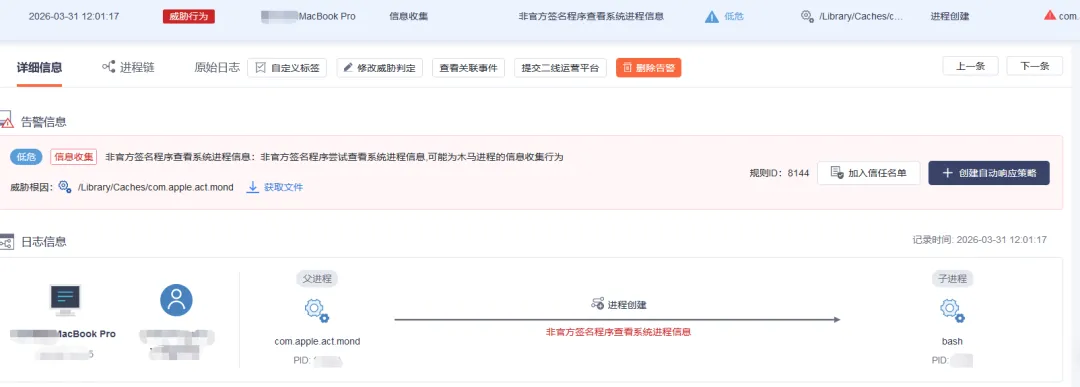
ThreatBook's OneSEC EDR platform detected malicious code executing in real time on machines running OpenClaw. The malicious packages have since been removed by npm, but any environment that installed either affected version should be treated as compromised.


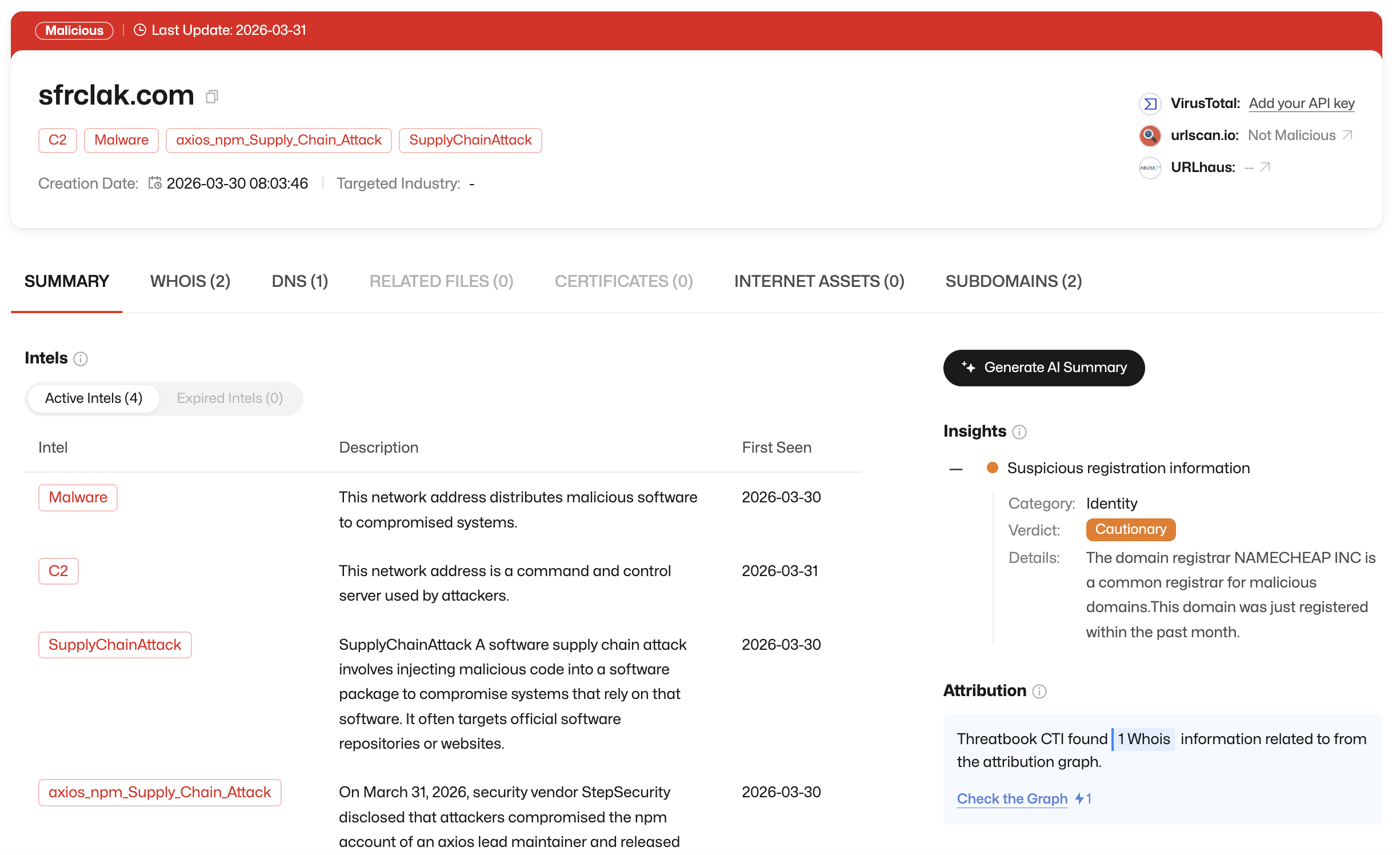
If you see any callback to sfrclak.com in your network logs, your host is compromised. Block this domain immediately and follow the remediation steps below.

Incident Summary

Field Details
Incident Axios npm supply chain poisoning — cross-platform RAT delivery
Affected Package axios (3.6+ billion annual downloads)
Affected Versions 1.14.1 and 0.30.4 (removed); safe version is 1.14.0 or earlier
Discovery March 31, 2026, ~00:05 UTC (Socket.dev automated detection)
Packages Removed March 31, 2026, ~04:00 UTC
Platforms Affected Windows, Linux, macOS
C2 Domain sfrclak.com
Potential Blast Radius All Node.js and browser applications making HTTP requests — React frontends, CI/CD tooling, server-side APIs

Attack Timeline (UTC)

  • March 30, 23:59:12 — Attackers publish malicious dependency package plain-crypto-js@4.2.1 to npm.
  • March 31, ~00:00 — Using a stolen Axios maintainer npm account, attackers bypass GitHub Actions CI/CD and manually publish axios@1.14.1 and axios@0.30.4, both referencing the malicious dependency.
  • March 31, 00:05:41 — Socket.dev automated scanning flags plain-crypto-js as anomalous.
  • March 31, 04:00:00 — npm removes plain-crypto-js@4.2.1, axios@1.14.1, and axios@0.30.4 from the registry.

Technical Analysis

Infrastructure Setup

On March 30, attackers registered the malicious domain sfrclak.com in preparation for the attack. This domain serves as both the C2 server and payload delivery endpoint.

The Poisoned Dependency: plain-crypto-js@4.2.1

The attack chain flows through a malicious transitive dependency. Both backdoored Axios versions reference plain-crypto-js@4.2.1 in their package.json. This package includes a postinstall hook in its own package.json that triggers execution of setup.js immediately upon installation — before the developer ever runs any application code.

The Loader: setup.js

setup.js is an obfuscated JavaScript loader. Its function is straightforward: fingerprint the host operating system, then fetch and execute the appropriate platform-specific payload from the attacker's server:

http://sfrclak[.]com:8000/6202033


This cross-platform targeting — Windows, Linux, and macOS — makes this attack significantly broader in scope than typical supply chain incidents, which often focus on a single OS.

ThreatBook's Cloud Sandbox S and OneSandbox platforms have confirmed detection of this behavior. The downstream payload is no longer retrievable for analysis, as the delivery URL has been taken down.

OneSEC EDR Detection

ThreatBook's OneSEC EDR detected the malicious code executing during OpenClaw installation on both Windows and macOS endpoints, providing real-time visibility into the attack at the point of execution.

Remediation Steps

1. Check for network callbacks to sfrclak.com

Any connection to sfrclak.com — inbound or outbound — confirms that the malicious loader executed on that host. Treat the host as compromised and escalate immediately.

2. Block malicious domains at the network layer

  • sfrclak.com
  • callnrwise.com

3. Audit your Axios version

Check whether your project uses axios@1.14.1 or axios@0.30.4:

bash
npm list axios


If either affected version is present, remove it and pin to 1.14.0 or an earlier known-good version.

4. Check for plain-crypto-js in node_modules

The presence of the plain-crypto-js directory in node_modules is sufficient to confirm the setup.js loader executed — even if the directory contents appear clean. The stub files may have been replaced after execution.

download (5)-png

5. Treat CI/CD pipelines as compromised

Any pipeline that ran an install of axios@1.14.1 or axios@0.30.4 should be considered compromised. Rotate all secrets and tokens injected into those pipelines immediately.

6. Check for RAT artifacts on affected systems

Audit running processes and persistence mechanisms on any host where the affected versions were installed. Engage your security team for a full forensic review.

Detection Coverage

ThreatBook's OneSEC endpoint security platform detected malicious code execution during OpenClaw installation on Windows and macOS hosts in real time.

The following ThreatBook platforms also support detection and blocking of the IOCs listed below:

  • Cloud Sandbox S
  • OneSandbox (Sandbox Analysis Platform)

IOCs

Indicator Notes
sfrclak.com C2 domain; RAT callback and payload delivery
callnrwise.com Associated attacker infrastructure
142.11.196.73 Suspected attacker-controlled asset
142.11.199.73 Suspected attacker-controlled asset
plain-crypto-js@4.2.1 Malicious npm package (postinstall loader)
axios@1.14.1 Backdoored Axios release
axios@0.30.4 Backdoored Axios release


The IPs listed above were identified through ThreatBook Research Team's pivot analysis as "highly likely" attacker-controlled assets. Organizations may wish to proactively block these at their discretion.

How a Malicious Plugin Turned OpenClaw Into a Credential Stealer

How a Malicious Plugin Turned OpenClaw Into a Credential Stealer

Last week, ThreatBook's endpoint detection product, OneSEC EDR, identified and fully captured an active attack targeting OpenClaw users. The attack...

Read More
SilverFox: Not an Organization, But a Tool - Uncovering the Underground Ecosystem

SilverFox: Not an Organization, But a Tool - Uncovering the Underground Ecosystem

Executive Summary For months, the cybersecurity community tracked what appeared to be a sophisticated cybercrime organization dubbed "SilverFox"....

Read More