3 min read

Apple Libnotify/notifyd Stack Overflow (CVE-2026-64739) — Discovered by ThreatBook XGPT

On July 27, 2026, Apple released security updates for iOS 26.6 and iPadOS 26.6, fixing vulnerabilities across several components — Accessibility, Kernel, Libnotify, and WebKit. Among them is CVE-2026-64739, a stack-based buffer overflow in Libnotify/notifyd found and reported to Apple by ThreatBook XGPT. Apple's advisory credits Feng XUE and XGPT of ThreatBook. The same flaw also affects tvOS, watchOS, visionOS, and macOS — see Affected Scope below. There is no evidence of in-the-wild exploitation or a public proof of concept in available sources, but Apple recommends applying this update as soon as possible.

TL;DR — Key Takeaways

  • Status: Patched July 27, 2026. Apple recommends updating as soon as possible. No evidence of in-the-wild exploitation or a public proof of concept in available sources.

  • Vulnerability type: Stack-based buffer overflow (out-of-bounds write) in Libnotify/notifyd's file-monitor path handling.
  • Apple's stated impact: "An attacker may be able to cause unexpected app termination."
  • Exploitation conditions: Local access, no privileges required, no victim interaction — but reaching code execution requires bypassing both the stack canary and arm64e Pointer Authentication Codes (PAC).
  • Fixed in: iOS/iPadOS/tvOS/watchOS/visionOS 26.6; macOS Sonoma 14.8.8; macOS Sequoia 15.7.8; macOS Tahoe 26.6. Full affected-version matrix below.
  • Discovered by: ThreatBook XGPT, credited in Apple's advisory alongside ThreatBook Co-Founder and CEO Feng XUE.

Vulnerability Overview

notifyd is Apple's system-level notification daemon, present across iOS, iPadOS, tvOS, watchOS, visionOS, and macOS. Applications register file-monitor requests with notifyd to be notified when a given file path changes.

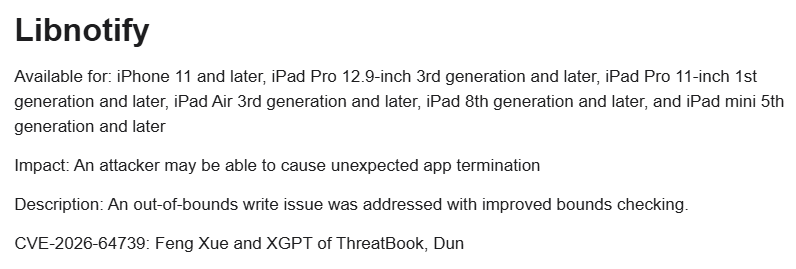
image-png-4
Figure 1 — Apple's security advisory for Libnotify, listing the fix and the CVE-2026-64739 credit.

ThreatBook traced the flaw to path-length validation in that registration path: notifyd does not correctly bound-check the length of an attacker-controlled path before copying it into a fixed-size stack buffer (MAXPATHLEN, 1,024 bytes), triggering a stack overflow.

Apple's stated impact — unexpected app termination — is consistent with the stack canary catching the corruption before it can be exploited. Reaching working code execution would additionally require defeating arm64e PAC, which authenticates return addresses on Apple silicon. With both the canary and PAC bypassed, the flaw could lead to local privilege escalation or root-level code execution. That is the ceiling defenders should assess against, not a demonstrated outcome. Triggering the overflow itself requires only an unprivileged local account — no elevated privileges, no victim interaction.

Affected Scope

Field Detail
Component Apple Libnotify/notifyd
Affected versions iOS/iPadOS < 26.6, tvOS < 26.6, watchOS < 26.6, visionOS < 26.6, macOS Sonoma < 14.8.8, macOS Sequoia < 15.7.8, macOS Tahoe < 26.6
Fixed versions iOS/iPadOS/tvOS/watchOS/visionOS 26.6; macOS Sonoma 14.8.8; macOS Sequoia 15.7.8; macOS Tahoe 26.6

Remediation

Overall priority: apply the update as soon as possible. Apple has not published a separate workaround — the fix ships in the OS update itself, with no interim configuration change or feature flag that mitigates the issue. A local-only attack surface and no known in-the-wild exploitation mean this isn't an active-incident scenario, but Apple's own guidance is to update promptly rather than wait for a routine cycle.

Category Attribute Value
Basic information CVE ID CVE-2026-64739
  Vulnerability type Stack-based buffer overflow (out-of-bounds write)
Exploitation conditions Attack vector Local — requires local access to the device
  Privilege required None — unprivileged local user
  Requires victim interaction No
  Requires bypassing security mechanisms for code execution Yes — stack canary and arm64e PAC must both be bypassed
Patch status Patch available

Yes — released July 27, 2026

Update through Settings > General > Software Update on iOS, iPadOS, tvOS, watchOS, and visionOS, or Software Update on macOS. Apple's advisory is at support.apple.com/en-us/128066.

How ThreatBook Protects You

In its July 2026 security release, Apple credited Feng XUE and XGPT — ThreatBook's autonomous AI security-research system — across multiple vulnerabilities, including CVE-2026-64739 in Libnotify. XGPT has also been credited with previously discovering a previously unknown macOS/iOS kernel flaw (CVE-2026-43722) and a heap buffer overflow in NGINX (CVE-2026-42055), both responsibly disclosed and now patched.

ThreatBook's vulnerability intelligence cataloged CVE-2026-64739 on July 28, 2026, the day after Apple's advisory. Vulnerability intelligence is part of ThreatBook ATI (Advanced Threat Intelligence), which tracks 400,000+ vulnerabilities, and the entry is updated as further detail becomes available. For how ThreatBook ATI covers findings like this, visit threatbook.io.

Lazarus Group Poisons Axios: Inside the npm Supply Chain Attack

1 min read

Lazarus Group Poisons Axios: Inside the npm Supply Chain Attack

Regarding yesterday's Axios npm supply chain poisoning incident, ThreatBook has conducted in-depth sample analysis and attack tracing. Drawing on...

Read More
Agentic Security Is the Architecture Decision

1 min read

Agentic Security Is the Architecture Decision

The defender math broke a few years ago. Not because the threats got worse. They did, but that has been true every year since the first SOC was stood...

Read More
Fastjson RCE (≤1.2.83): Active Exploitation Detected — Detection & Mitigation

1 min read

Fastjson RCE (≤1.2.83): Active Exploitation Detected — Detection & Mitigation

A remote code execution vulnerability in Fastjson affects every version up to and including 1.2.83. A remote attacker can run arbitrary code on a...

Read More